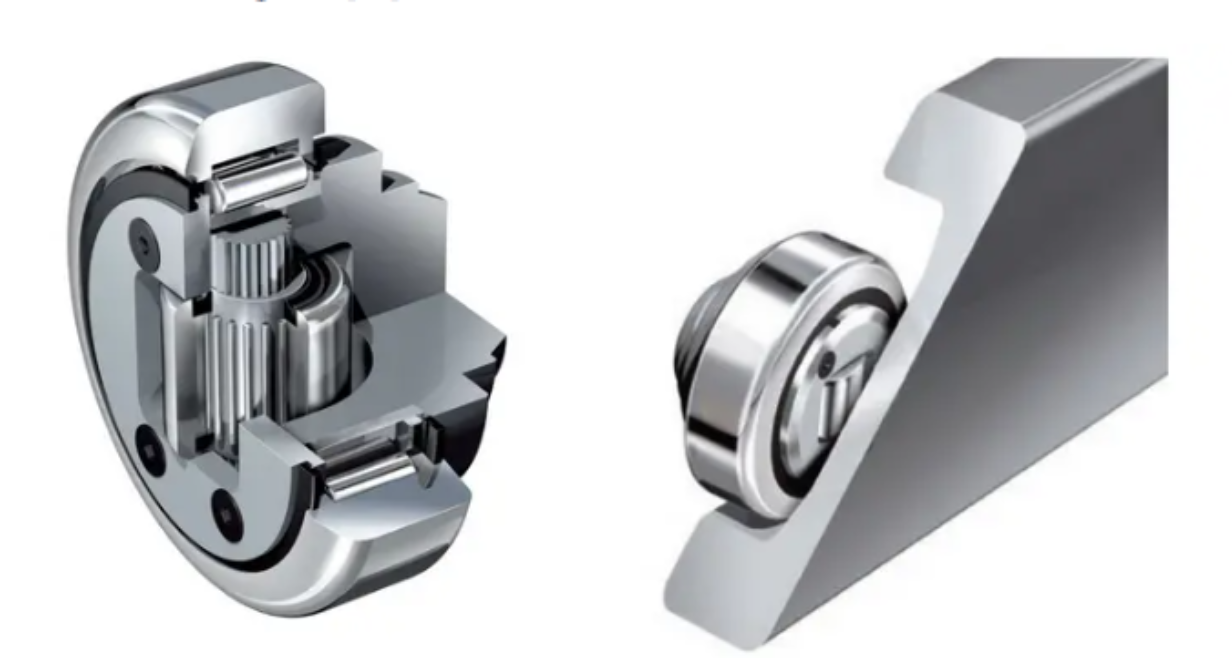
What is Combined Bearing Technology?
Combined bearings are roller bearings designed to carry both radial and axial loads simultaneously. Their unique construction allows the axial and radial bearings to operate at 90°, where the radial bearing supports the primary load and the axial bearing manages side thrust. These bearings are commonly used with I and C profile rails to enable smooth and precise linear motion.
Typically, combined bearings are welded with a flange plate for mounting, customized according to application requirements. This configuration is ideal for heavy-duty vertical and horizontal movements requiring high precision.
How Are Combined Bearings Different from Other Linear Motion Technologies?
Combined bearings are particularly suited for high-load applications and harsh environments such as dusty or high-temperature conditions. They serve as a robust alternative to conventional linear guides and ball screws where durability and load handling are critical.
Selection Parameters for Combined Bearings
- Load Capacity: Includes operational load and dead weight.
- Load Distance: Distance of the load from the suspension or support point.
- Bearing Distance: Distance between combined bearings in the assembly (recommended 500–1000 mm).
- Size Range: Selected based on outer diameter (O.D.). Standard: 52.5 mm to 153.8 mm; Jumbo: 180 mm to 320 mm.
- Other Factors: Operating environment, temperature, and installation conditions.
Applications of Combined Bearings
- Steel Industry: Pickling lines, edge wiper machines in CRM, billet conveyors, furnace trolleys, transfer cars in BSM, WRM, and HSM.
- Material Handling: Forklifts (Toyota, Baoli), palletisers, and automated transfer systems.
- Aluminium Industry: Stack loaders, sow casting machines, PTM machines, billet casting plants.
- Automobile & Power: Line builders, electrical and power equipment.
- Other Industries: Automation systems, packaging machines, woodworking, paper industry, and general machine building.
Leading Manufacturers of Combined Bearings
Winkel GmbH (Germany) is a pioneer and global leader in combined bearing technology with over 38 years of experience in heavy-duty lifting and motion systems.
- Alfatec – Germany
- Euro-Bearings LTD – UK
- C.R. Bearings – Italy
- FARO Bearings – Italy
- WD Bearings – China